We invite you to visit: Ear, Nose, and Throat Associates of Chester County
Christopher Hove, MD
One of the most common questions I hear during rhinoplasty consultations is some version of, "Which technique is better, open or closed?"
Here's what I tell my patients on the Main Line: it's the wrong question to start with. The better question is, what does your nose need, and which approach gives me the precision to deliver that result?
I've been performing open, closed, and reconstructive rhinoplasty for over two decades. At Hove Center for Facial Plastic Surgery, I don't default to one technique. I choose the approach that fits the individual, because every nose is different, and the technique should serve the anatomy, not the other way around.
Let me walk you through how I think about this decision.
Understanding the Basics
At their core, both approaches accomplish the same goal: reshaping the nose to improve its appearance, its function, or both. The difference is access.
Both are legitimate, effective techniques. Neither is inherently "better." What matters is which one gives me the control and visibility I need for your specific goals.
Real Results
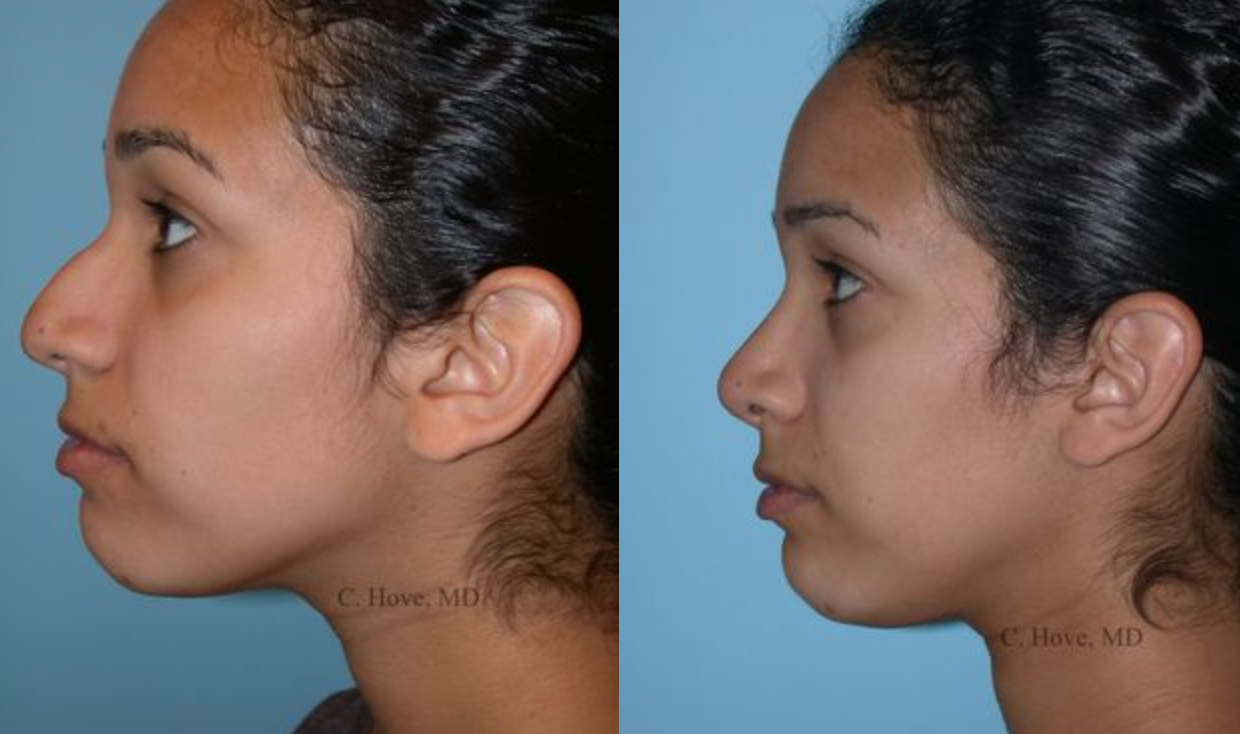
This patient had a prominent dorsal hump that bothered her for years. Using a tailored surgical approach, I refined the bridge to create a smoother, more balanced profile while preserving the natural character of her nose.
My Approach
My background as both a surgeon and a published medical illustrator has shaped the way I evaluate every nose. Medical illustration requires you to understand anatomy not just mechanically, but visually: how structures relate to one another, how proportion shifts the perception of a face, and where the eye naturally travels.
When I look at a nose, I'm simultaneously thinking about what's underneath and what the result will look like from every angle. That dual perspective informs which approach I recommend, and how I execute it. Before I think about open or closed, I think about structure, proportion, and balance:
Closed rhinoplasty tends to involve a slightly shorter procedure time and a somewhat faster initial recovery, since there's less disruption to the tissues. Open rhinoplasty gives me an unobstructed view of every cartilage, bone, and soft tissue structure. For complex work, that visibility isn't a luxury. It's a necessity.
Addressing a Common Concern
This is always important to patients who might need open rhinoplasty, and I understand the concern. But I want to put it in perspective.
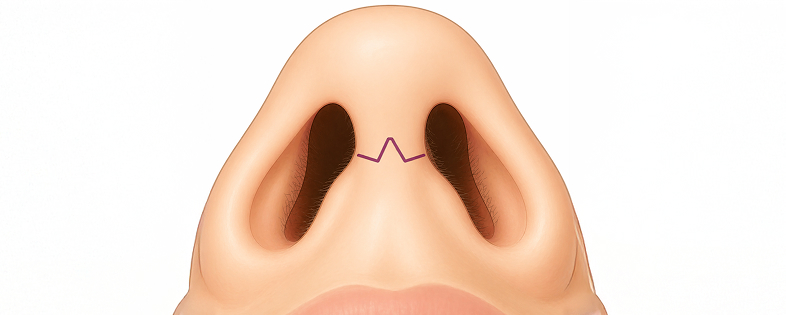
The columellar incision in open rhinoplasty is very small, just a few millimeters, and it's placed in a spot that's naturally shadowed by the nose. In my experience, the vast majority of my patients forget it's there within a few months. It heals to a fine line that's virtually invisible.
I would never choose a technique based on scar avoidance alone if the open approach is what your nose actually needs for the best outcome. A barely perceptible scar is a small trade-off for a result you can love for the rest of your life.
My Philosophy
What I've learned over more than 20 years, from training at Stanford, to running my own practice, to the hundreds of complex cases other surgeons have referred to me, is that technique should be adaptable.
A surgeon who performs every rhinoplasty the same way, using the same approach regardless of the patient, is likely compromising results for some of those patients. I've built my practice around the opposite principle: I assess your anatomy, listen to your goals, and then choose the approach that gives me the best chance of achieving a result that looks natural, functions well, and lasts.
I approach each rhinoplasty as both a surgeon and an artist. The nose has to be in harmony with the rest of your face. Understanding proportion and balance isn't just an aesthetic preference. It's something I bring to every procedure, whether open or closed.
Patient Story
Kerry Ashcroft is a nurse practitioner at the Children's Hospital of Philadelphia and a mom of three. When it came time to choose a surgeon for her own rhinoplasty, she did what any medical professional would: she asked her colleagues. The recommendation was unanimous. Kerry consulted me about correcting a deviated septum and refining the appearance of her nose. "I was looking for a more feminine appearance," she says. "Dr. Hove was able to take my vision and make it a reality."
Next Steps
When you visit our Paoli office, here's what our conversation will look like:
I'll examine your nose, externally and internally, to understand your bone structure, cartilage, skin thickness, and nasal function. We'll talk about what bothers you, what you'd like to change, and what kind of result would make you feel confident.
From there, I'll explain which approach I'd recommend and why. I'll walk you through what the procedure involves, what recovery looks like, and what you can realistically expect.
There's no pressure and no rush. This is a decision you should feel completely comfortable with.
We'd love to hear what you have in mind.
Recovery Comparison
This is another question I get often, and the honest answer is: slightly, but probably less than you'd expect.
With a closed rhinoplasty, there's typically a bit less swelling in the first week or two because the tissues haven't been lifted as extensively. These patients may feel comfortable going out in public sooner than open rhinoplasty patients.
With an open rhinoplasty, the initial swelling around the tip can take a little longer to settle, simply because more tissue was accessed during surgery. But we're talking about a difference of days, not weeks.
In both cases, I don't routinely use nasal packing, which makes a significant difference in comfort, no matter which approach we use. A splint protects the nose for about a week, and most patients are back to their normal routine within 10 to 14 days.
The bigger picture: the subtle differences in early recovery between open and closed rhinoplasty should never be the reason you choose one over the other. The technique that gives you the best long-term result is always worth a few extra days of patience.
The Bottom Line
If there's one takeaway to leave with, it's this: the technique matters far less than the surgeon's judgment in choosing it.
A skilled surgeon who masters both open and closed approaches, and who understands when to use each, will consistently deliver better outcomes than a surgeon who relies on a single technique for every patient.
At Hove Center, that's exactly the standard we hold ourselves to. Our practice focuses exclusively on the face and neck, and that specialization means you're getting a surgeon whose entire career is dedicated to this one area of the body.
If you've been thinking about rhinoplasty and want an honest, no-pressure conversation about your options, we're here for you.
Schedule a consultation at our Paoli, PA, office.
Dr. Christopher R. Hove uses his refined skills and artistic touch to create exceptional results through facial plastic surgery. Specializing exclusively in facial procedures, Dr. Hove provides cosmetic and reconstructive surgery as well as nonsurgical enhancements. Dr. Hove is a member of:
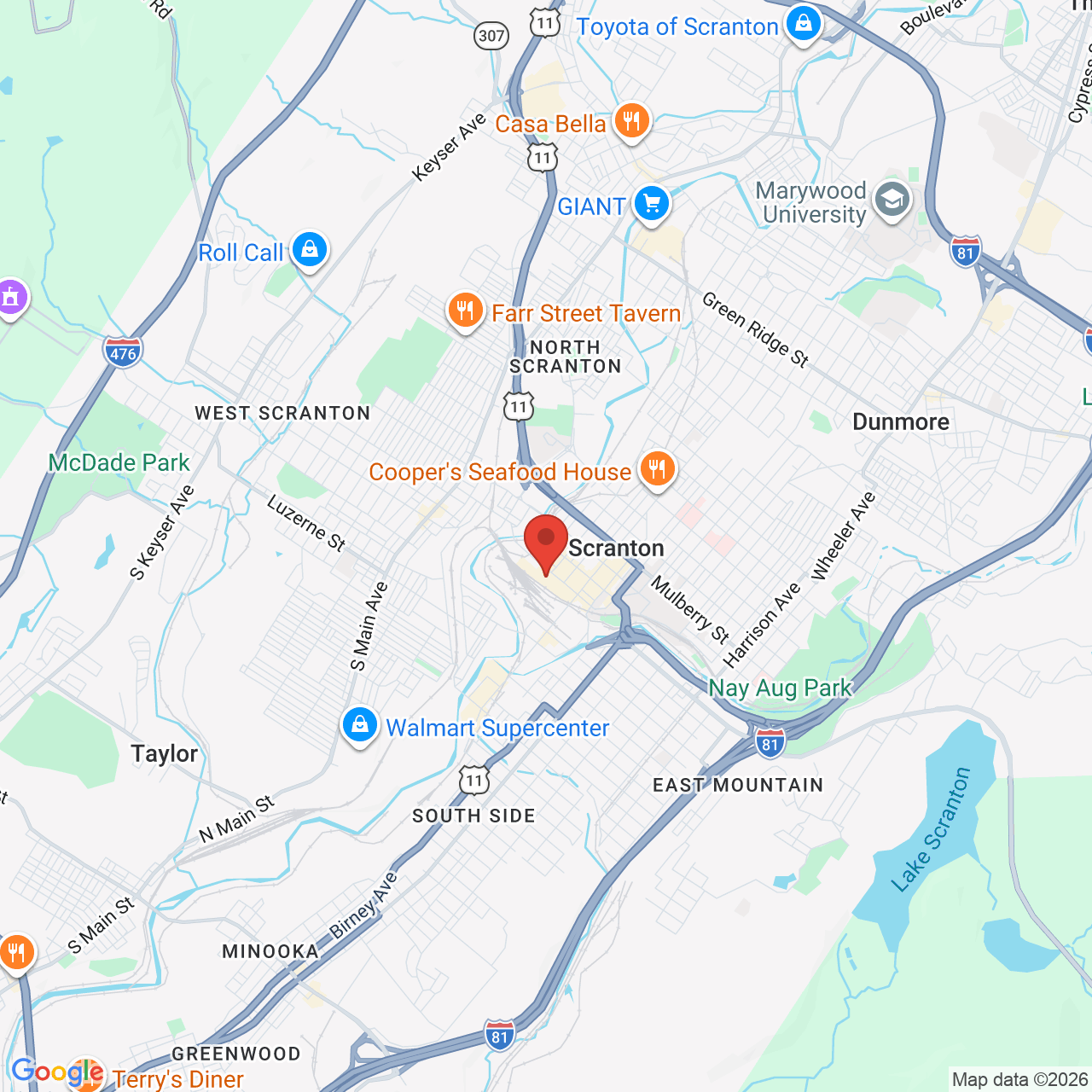
Schedule a consultation with Dr. Hove at our Scranton, PA, office by contacting us online or by calling (610) 647-3727.